


Cotati-Rohnert Park Unified School District (CRPUSD) is proud to serve our community and provide high-quality educational opportunities for more than 6,200 Cotati-Rohnert Park students. Our
teachers, staff, and leaders are deeply committed to creating safe, supportive, and engaging learning environments where every student can thrive. In all of our work, students remain at the
heart of every decision we make.
Over the past several weeks, the District and Board of Trustees have been carefully reviewing our financial situation and sharing information about the budget challenges we are facing, as
well as the thoughtful steps being taken to plan responsibly for the future.
Budget Reduction Update - March 2026
Understanding Our Budget Challenges
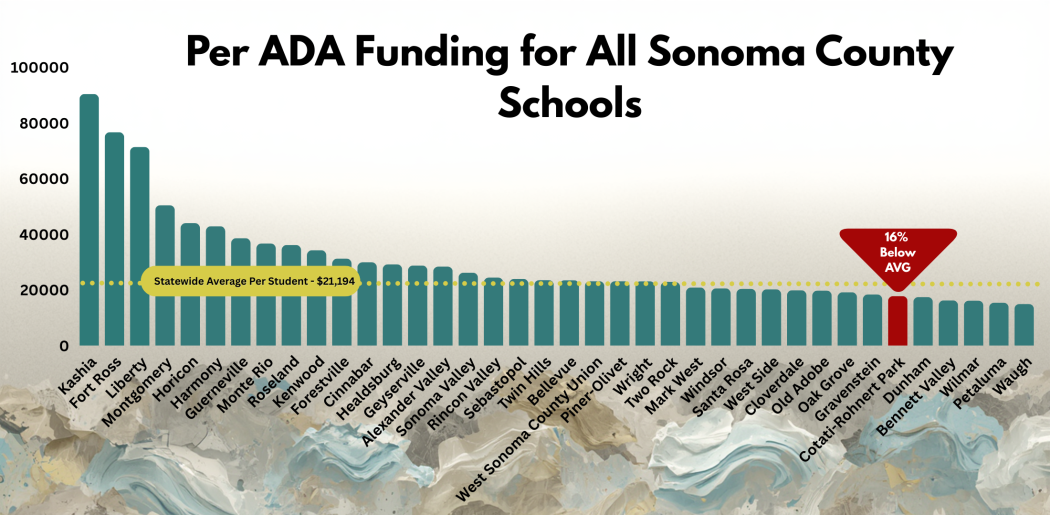
CRPUSD receives most of its funding from the State of California. Unfortunately, state budget forecasts, which districts rely on to plan responsibly, have proven increasingly unreliable. Over the past three years, state funding has come in lower than projected, contributing to an approximately $5 million ongoing funding gap in the District’s budget. We are also anticipating reductions in federal funding, which may further widen this gap.
Additional factors have compounded these challenges, including:
- Declining enrollment and average daily attendance (ADA)
- Rising health care, utility, and operating costs
- The expiration of one-time COVID relief funds that previously supported staffing and student programs
During public meetings, District staff explained how these factors have created a structural deficit, meaning the gap affects not just one year, but future budgets as well. Our Chief Business Official reviewed how restricted and unrestricted funds work, what reserves are required by state and local policy, and shared multi-year financial projections under optimistic, baseline, and conservative scenarios.
Thoughtful and Transparent Planning
The District also shared the conditions under which budget decisions must be made, including collective bargaining requirements, statutory notice timelines, credentialing and assignment
rules, and the need to continue providing required services such as Special Education and other programs that have restricted/categorical funding.
Possible budget-balancing scenarios were presented that combine efficiencies, potential revenue options, and reductions while clearly distinguishing between one-time solutions and the ongoing
changes needed to stabilize the District’s finances. Throughout this process, individual employee confidentiality has been respected.
Board Trustees asked thoughtful questions, discussed trade-offs, and focused their guidance on minimizing impacts to students and classrooms. A timeline was shared outlining labor collaboration, community input, refinement of options, and future Board action dates. Families and staff continue to have opportunities to share feedback through surveys and the District website.
Moving Forward Together
We recognize that conversations about budgets can be concerning for families. Please know that CRPUSD remains committed to fiscal responsibility, transparency, and community partnership, while keeping student safety, learning, and well-being at the center of every decision.
While the choices ahead will be difficult, we will continue to move forward with care, listen closely to our community, and communicate openly. Additional information will be shared as planning continues, and we welcome your continued input and engagement.
Together, we remain focused on what matters most, supporting our students and ensuring they receive an outstanding education.
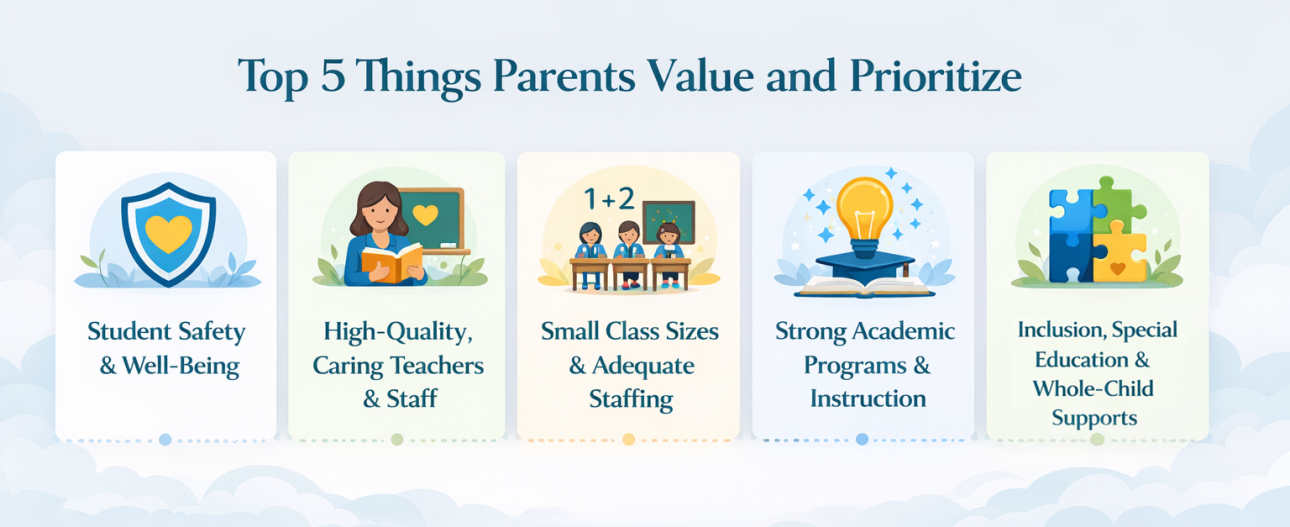
*Information provided by the Community Outreach Survey
Board Study Session
A Board Study Session is a public meeting held by the Board of Trustees with dedicated time to deeply explore important district topics. Unlike regular board meetings, study sessions are designed for exploration and understanding rather than formal action. These sessions allow board members to review information, ask questions, and gain clarity on complex issues to support informed decision-making in future meetings. Families and community members are welcome to attend and observe these discussions.
District Communications
Our district is committed to clear, timely, and transparent communication with our community. We use ParentSquare as our primary communication platform to share important updates, announcements, and reminders directly with families. The ParentSquare portal will be the fastest way for families to receive this information. In addition, key messages are posted on the front page of our district website in the ParentSquare feed. Recent updates will also be accessible below, ensuring information is easy to find and available to the broader community.

SCOE First Interim Report for Fiscal Year 2025-26 Letter - January 12, 2026
Correspondance from SCOE regarding First Interim Report for Fiscal Year 2025-26
CRPUSD First Interim Report - As of October 31, 2025
A First Interim Report is a mid-year financial update that school districts are required to present to their governing board and community. It provides an overview of the district’s current financial status, including revenues, expenditures, and projections for the remainder of the school year. This report helps ensure transparency and accountability, and confirms whether the district is on track to meet its financial obligations while continuing to support student programs and services.
| Meeting | Date | Content | Audience |
| Budget Advisory | October 16, 2025 | Budget update | Budget Advisory Council |
| Board Meeting | November 18, 2025 | Budget Update | Public |
| Principal meeting | December 4, 2025 | Budget Update | Leadership |
| Board Meeting | December 9, 2025 | First Interim | Public |
| IBB with RPCEA | December 9, 2025 | Initial conversations about budget ideas | IBB Team |
| Message to staff and community | December 16, 2025 | Informing community | Public |
| IBB with SEIU | December 16, 2025 | Negotiation on budget reduction | IBB Team |
| Budget Advisory | December 18, 2025 | First Interim and input | Public |
| IBB with RPCEA | January 6, 2026 | Negotiation on budget reduction | IBB Team |
| Principal meeting | January 8, 2026 | Budget Update | Leadership |
| IBB with SEIU | January 12, 2026 | Confirming budget reductions and MOU | IBB Team |
| IBB with RPCEA | January 13, 2026 | Confirming budget reductions and MOU | IBB Team |
| Board Study Session | January 13, 2026 | AGENDA | Public |
| Communication to the community | January 14, 2026 | Letter | Public |
| Board Meeting | January 20, 2026 | Regular scheduled agenda | Public |
| Individual Staff Meetings | by February 12, 2026 | Verbal Notification to staff impacted by layoffs | Principals and Management to Impacted Staff |
| Board Meeting | February 17, 2026 | Certificated and Classified Resolution - permission to lay off positions | Public |
| Message to staff and community | February 18, 2026 | Board meeting results | Community |
| IBB with CSEA | February 19, 2026 | Negotiation on budget reduction | IBB Team |
| Board Meeting | March 3, 2026 | Bring Names of Staff Laid off to Closed Session | Public |
| Individual Staff Meetings | March 4-6, 2026 | Hand Deliver lay off notices to impacted staff | Admin to staff |
| Board Meeting | March 10, 2026 | Any Additional Preliminary Layoffs/Staff Reductions if required | Public |
| Individual Staff Meetings | March 11, 2026 | Hand Deliver lay off notices to impacted staff | Cabinet to Impacted staff |
| Staff Deadline to Request an OAH Hearing | March 14-23, 2026 | 7-10 days after served to request a hearing | TBD |
| Hearings Results provided to the District | May 7th, 2026 | TBD | |
| Board Meeting | May 12th, 2026 | Final Lay off/ Staff Reduction to the board and consider hearing Results if any | Public |
| Individual Staff Meetings | May 13, 2026 | Hand Deliver lay off notices to impacted staff | Admin to staff |
Budget Reduction Process
The following is a summary of the District’s budget reduction work spanning the 2024–2025 and 2025–2026 school years. This has been a two-year planning process, guided by a strong commitment to students, staff, and transparency. While we had hoped that earlier planning would prevent us from facing difficult decisions this year, changing financial conditions have required us to continue with these difficult decisions.
Ongoing Budget Conversations
The District has shared budget information publicly and invited input throughout this process. Budget updates and discussions have taken place at the following Budget Advisory Committee (BAC) and School Board meetings. Additionally, a community survey was shared on ParentSquare, and these ideas are being considered and incorporated into our FAQs on the CRPUSD website.
Past Meetings
- September 19, 2024 (BAC)
- October 17, 2024 (BAC)
- November 16, 2024 (BAC)
- February 20, 2025 (BAC)
- May 22, 2025 (BAC)
- October 16, 2025 (BAC)
- November 18, 2025 (School Board meeting)
- December 16, 2025 (School Board meeting)
- December 18, 2025 (BAC)
- January 13, 2026 (School Board meeting)
- January 15, 2026 (BAC)
Upcoming Meetings
- February 17, 2026 (School Board meeting)
- February 19, 2026 (BAC)
- March 3, 2026 (School Board meeting)
- March 10, 2026 (School Board meeting)
- March 19, 2026 (BAC)
- April 21, 2026 (School Board meeting)
- April 16, 2026 (BAC)
- May 19, 2026 (School Board meeting)
- May 21, 2026 (BAC)
Families are always encouraged to attend and share feedback.
What Happened in 2024–25
During the 2024–2025 school year, the District identified an estimated $2 million budget shortfall. A Budget Advisory Council (BAC), made up of staff and community members, met throughout the year to review the budget and explore possible cost-saving options.
Several ideas were discussed and carefully evaluated. Some were ultimately removed from consideration, while others remained as possible future options. By the end of the school year, revenues came in higher than expected, reducing the shortfall. As a result, only minimal cuts were needed at that time.
Why the Challenge Grew in 2025–26
At the start of the 2025–2026 school year, new information showed that the budget gap was larger than previously projected. By December 2025, the deficit had increased to approximately $5 million.
This increase was due to:
- Rising costs for health benefits, staffing, and daily operations
- Lower-than-expected revenue caused by declining enrollment and attendance
- Lower than expected Cost of Living Adjustment (COLA)
Because groundwork had already been laid during 2024–2025, the District was better prepared to respond thoughtfully rather than react suddenly.
How Decisions Are Being Made
Ideas developed during 2024–2025, along with additional strategies, formed the basis for budget reduction recommendations being considered for 2026–2027.
Over the past three months, District leadership has worked closely with employee groups (SEIU, CSEA, and RPCEA) to understand which cost-saving ideas could be supported. These conversations are ongoing, and collaboration will continue as we navigate this challenging period together.
Guiding Principles for Reductions
To ensure fairness and protect students as much as possible, budget reductions are guided by the following principles:
- Cuts are spread across departments rather than concentrated in one area
- Reductions reflect the overall makeup of staff groups
Additionally, many reductions focus on one-time funding sources, which helps limit long-term impacts.
The Educational Services Department will be reduced by approximately 80%, reflecting the loss of temporary funding rather than a reduction in the importance of student services.
Moving Forward Together
Every suggestion brought forward by the Budget Advisory Council was explored; some remain under consideration, while others were determined not to be viable. Throughout this process, the District remains committed to:
- Prioritizing student safety and learning
- Being transparent with families and staff
- Listening to community feedback
- Making decisions with care and compassion
We know these conversations can be difficult, and we deeply appreciate the partnership of our families and community as we work together to support students now and into the future.
CRPUSD Budget FAQ's
How a School Budget Differs from the Private Sector?
Unlike a private-sector budget, a school district budget is largely driven by enrollment, state formulas, and legally restricted funds that must be used for specific purposes. School budgets are planned years in advance, must balance annually, and prioritize long-term stability and equity rather than profit. These differences reflect our responsibility to serve all students, steward public funds carefully, and remain accountable to the community.
How does school money work?
- What it is: Dollars we receive in a single year (e.g., special state/federal allocations).
- What it can fund: Short-term things, temporary staff, retention stipends, one-time purchases (books/devices), short-term programs, and professional development.
- What it should not fund: Ongoing costs (like permanent raises) because the money doesn’t repeat.
- What it is: Dollars legally earmarked for a specific purpose (e.g., after-school programs, nutrition services, construction).
- Key point: We must spend these funds only on the program they’re meant for; they can’t plug a general budget gap.
- What it is: Our day-to-day operating funds, largely based on student attendance (ADA).
- What it pays for: Staff salaries and benefits, classroom programs, transportation, supplies, utilities, and everything it takes to run schools.
Why does attendance matter financially?
- TK: 35 absences → $3,511.55
- K–3: 162 absences → $11,231.46
- 4–6: 113 absences → $7,223.84
- 7–8: 88 absences → $5,791.87
- 9–12: 176 absences → $13,774.94
Can we use after-school or bond money to cover the deficit?
- After-school funds (ELOP/ASES): must expand the learning day or year (after-school/summer). They cannot be moved to general operations.
- Bond funds: can only be used for buildings and infrastructure (modernization, safety upgrades, and some technology tied to facilities). They cannot pay for staffing or ongoing operating costs.
Can we cut more administrators?
As we prepare for the 2026–2027 school year, we are working to align cuts with how our revenue is spent. About 53% of our budget goes to teachers, 11% goes to
administrators, and the remaining portion supports our classified staff.
Even though administrators make up only 11% of the budget, we reduced administrative positions by 22%, which is a significant cut.
Administrators play a critical role in our schools. Their job is to support teachers and students by:
- Making sure teachers have what they need to be successful in the classroom
- Removing barriers so teaching and learning can happen
- Ensuring we meet all safety, legal, and educational requirements
- Supporting parent engagement and teacher learning
- Keeping schools running smoothly day to day
District administrators also support school site leaders, teachers, and students by ensuring our schools are safe and meeting high standards for student learning.
How can parents help?
We truly value parent and community involvement. You can support our budget work by:
- Participating in School Site Council or English Learner Advisory Committees
- Attending school board meetings
- Sharing questions, feedback, or concerns about the budget
Your input matters. Educating your children is the most important work we do, and hearing from families helps us make better decisions.
If you have questions or would like to get involved, you can contact your school site or the district office. You may also use the “Contact Us” button on our website—messages are reviewed and answered as they come in. We also encourage you to complete our community survey to share feedback and ask questions.
What is the difference between a bond and a parcel tax?
A simple way to think about it is:
Bonds are for buildings. Parcel taxes are for people.
- Bond funds can only be used for facilities—such as building construction, repairs, maintenance, and infrastructure. By law, this money cannot be used for staff or programs.
- Parcel tax funds are more flexible and can be used to support staff and educational programs.
We recently passed a parcel tax without asking for an increase. This means those funds are currently helping maintain the programs and staffing levels that were already in place.
We are very grateful to the CRPUSD community for passing both a bond and a parcel tax this past year.
Can we cut sports or enrichment programs?
People often ask whether cutting sports or enrichment programs would solve our budget challenges. In reality, these programs represent a very small portion of the district’s overall budget, and much of the funding that supports them is restricted, meaning it must be spent for specific purposes and cannot legally be redirected to cover general operating costs.
For many students, sports, arts, and enrichment are not extras; they are what make school engaging and meaningful. For some, a coach, art teacher, or music instructor is the adult they connect with most, and that relationship plays a critical role in keeping them motivated, connected, and coming to school.
These programs provide students with safe, positive spaces to learn, grow, and belong, whether on the field, on the stage, or in the classroom. They also support student well-being, attendance, school climate, and academic success in ways that extend beyond the classroom.
Our goal is to offer a well-rounded education that prepares students for life beyond school. While we continually review all programs for effectiveness and sustainability, maintaining a balanced educational program is an important part of achieving that goal, and eliminating programs that serve students well would not meaningfully solve the district’s broader financial challenges.
Common School Acronyms
Funding & Budget Acronyms
-
LCFF – Local Control Funding Formula
-
LCAP – Local Control and Accountability Plan
-
ADA – Average Daily Attendance
-
COLA – Cost of Living Adjustment
-
GF – General Fund
-
SACS – Standardized Account Code Structure
-
MYP – Multi-Year Projection
-
EOY – End of Year
- UFB – Unrestricted Fund Balance
Student Programs & Services
-
SPED – Special Education
-
IEP – Individualized Education Program
-
504 Plan – Section 504 Accommodation Plan
-
MTSS – Multi-Tiered System of Supports
-
EL – English Learner
-
RFEP – Reclassified Fluent English Proficient
-
GATE – Gifted and Talented Education
-
SEL – Social-Emotional Learning
- PBIS – Positive Behavioral Interventions and Supports
Instruction & Learning Programs
-
TK – Transitional Kindergarten
-
CTE – Career Technical Education
-
AP – Advanced Placement
-
IB – International Baccalaureate
-
STEAM – Science, Technology, Engineering, Arts, Math
-
VAPA – Visual and Performing Arts
- ELD – English Language Development
Expanded Learning & Student Support
-
ELOP – Expanded Learning Opportunities Program
-
ASES – After School Education and Safety Program
-
OST – Out-of-School Time
-
SST – Student Study Team
- RTI – Response to Intervention
Staffing & Labor
-
FTE – Full-Time Equivalent
-
HR – Human Resources
-
CSEA – California School Employees Association
-
CTA – California Teachers Association
- SEIU – Service Employees International Union
Facilities & Capital Funding
-
GO Bond – General Obligation Bond
-
CUPCCAA – California Uniform Public Construction Cost Accounting Act
-
DSA – Division of the State Architect
- MP – Master Plan (Facilities)
Accountability & Compliance
-
CDE – California Department of Education
-
FAPE – Free Appropriate Public Education
-
FERPA – Family Educational Rights and Privacy Act
-
OCR – Office for Civil Rights
- WASC – Western Association of Schools and Colleges
Nutrition & Student Needs
-
NSLP – National School Lunch Program
- CEP – Community Eligibility Provision
- McKinney-Vento – Homeless Student Support Program